A deep drawing press is better for complex hollow parts. Stamping presses cut and form flat or shallow shapes; deep drawing presses control metal flow through a die to produce seamless, high-depth hollow parts in one cycle.
What Separates Deep Drawing From Stamping in Process Terms?
Deep drawing is a controlled metal-flow process, while stamping is a shear-and-form process — and that difference decides which machine can make a complex hollow part. In deep drawing, a punch pushes a blank through a die while the blank-holder applies counter-pressure, so material flows radially inward instead of tearing. The result is a seamless cup or shell with a wall height often several times the blank thickness. Stamping relies on a single stroke to blank, pierce, bend or coin; it excels at flat parts and shallow forms but cannot redistribute material into a deep cavity. For sinks, LPG cylinders and similar drawn shells, the deep drawing press is the correct machine category, not a stamping press with a larger tonnage.
Which Machine Parameters Actually Decide the Outcome?
The deciding parameters are draw depth, blank-holder force, stroke and opening height — not tonnage alone. A deep drawing press needs enough stroke to carry the punch through the full draw, enough opening height to load the blank and remove the finished shell, and independent control of blank-holder or ejector force so the flange does not wrinkle or thin out. A stamping press is normally specified by tonnage, bed size and strokes per minute, because its job is shear force and cycle speed. Buyers who size a stamping press for a deep part usually discover the press lacks the stroke, the cushion or the pressure stability the draw requires. JIUYING configures tonnage, table size, stroke and opening height around the customer’s process for exactly this reason.
How Do Hydraulic and Mechanical Drives Compare for Deep Drawing?
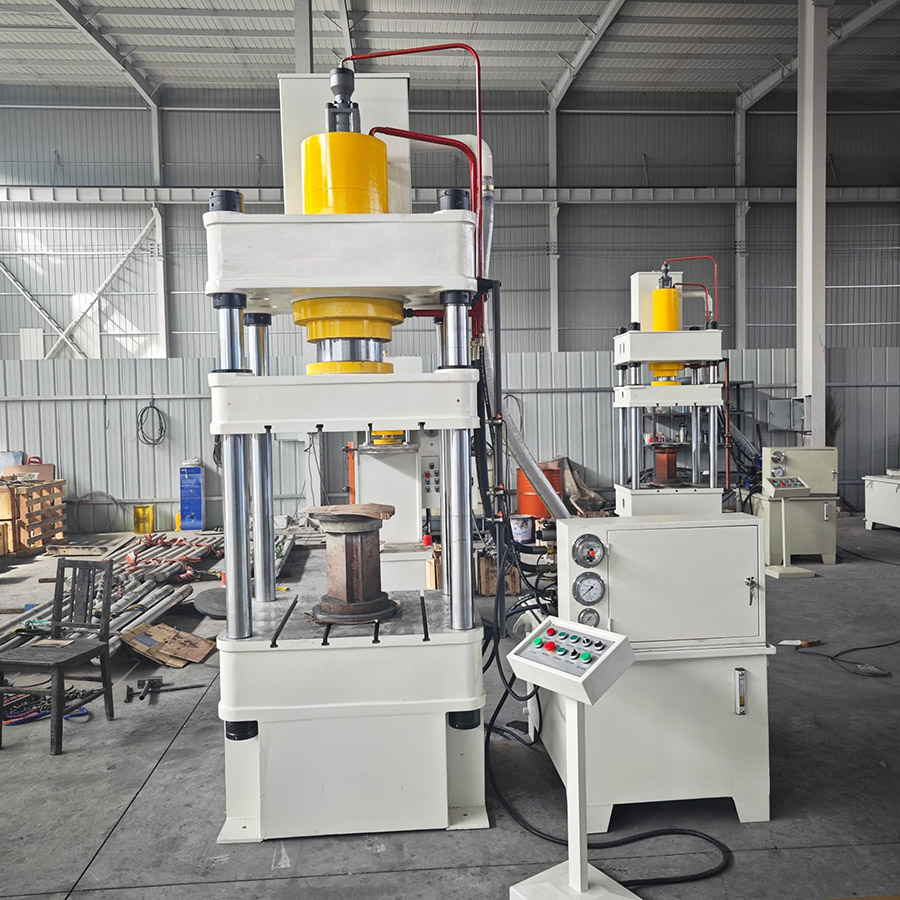
A hydraulic drive is generally preferred for deep drawing because it delivers full force through the entire stroke and holds pressure at the bottom dead centre. Deep drawing needs sustained force as the punch travels, plus a controlled dwell so the material can flow without springback or tearing. Mechanical stamping presses deliver peak force near the bottom of the stroke and run faster, which suits blanking and piercing rather than deep shells. Hydraulic architecture also makes the blank-holder and ejector easy to tune. JIUYING builds cartridge-valve hydraulic systems with fewer leak points and stable pressure through the full stroke, and fits a PLC touch screen so draw parameters are changed as settings rather than as a mechanical rebuild.
What Should a Buyer Check Before Ordering?
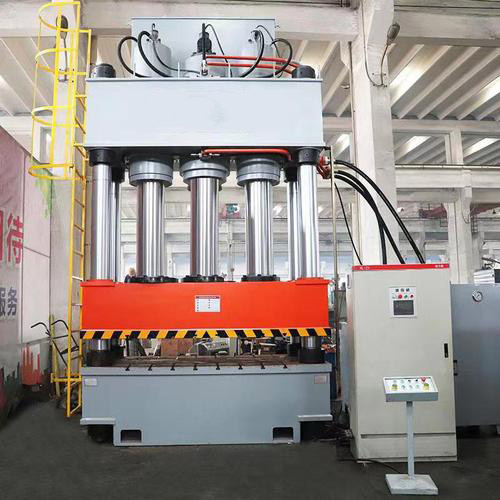
Check four things before ordering: the part’s draw ratio, the die set you already own, the required surface finish, and whether the machine can be re-configured later. Confirm the press can accept your existing die — a supplier who will not size the machine around your tooling forces you to buy new dies. Verify structural rigidity, because a frame that loses parallelism distorts draw depth over years of pressing. Confirm the hydraulic circuit holds pressure, since unstable pressure shows up directly as inconsistent draw depth. Finally, confirm changeover speed: switching between drawing, piercing and embossing should be a parameter change. JIUYING (J&Y) builds three-beam four-column presses on stress-relieved Q235 welded frames with Columnas guía de acero 45#, quenched and hard-chrome plated, and offers deep-drawing versions for sinks and LPG cylinders with ejector cylinders available.
Conclusión
For complex hollow parts, specify a deep drawing press, not a stamping press. Match stroke, opening height and blank-holder force to your draw ratio, insist the supplier sizes the machine around your existing die set, and confirm hydraulic pressure stability. Review the JIUYING range at https://www.cncsheetmachine.com/ before you commit.
Preguntas frecuentes
Can a stamping press be used for deep drawing?
A stamping press can perform shallow drawing, but a stamping press is generally a poor choice for complex hollow parts because the stamping press usually lacks the stroke, opening height and independent blank-holder control that deep drawing requires. Buyers needing deep shells should specify a dedicated deep drawing press sized to the draw ratio.
What tonnage do I need for a deep drawing press?
Deep drawing press tonnage depends on blank diameter, material strength and draw depth, not on part volume alone. The practical approach is to give the press builder your die set and part drawing so the builder calculates tonnage, table size, stroke and opening height together. JIUYING sizes each hydraulic press around the customer’s existing die set rather than a catalogue model.
Why does draw depth vary between parts on the same press?
Draw depth varies when hydraulic pressure is unstable or the frame loses parallelism under load. A cartridge-valve hydraulic system with fewer leak points holds stable pressure through the full stroke, and a stress-relieved welded frame with hard-chrome plated guide columns keeps the slide square, so every part draws to the same depth.
How long does changeover take between drawing and embossing?
Changeover time depends on whether the press is parameter-driven or mechanically rebuilt. On a PLC touch-screen press, switching between drawing, piercing and embossing is a settings change plus a die swap, which is far faster than rebuilding a mechanically set machine. Confirm the control architecture before purchase, because it decides long-term changeover time.

 EN
 RU
 ES